Monday, October 27, 2008
Church and State and Proposition 8
My husband found some remarkably good articles about how Porposition 8 does not threaten the separation of church and State and how imposing same sex marriage is threatining the constitutional rights of freedom of speech and religion I really reccomend them to anybody who wants some good secular arguments on the subject. The main site ChurchState.org has a wealth of information, well researched, and written by people of conscience who understand our nation's laws and its ramifications.

Sunday, October 26, 2008
is it a choice?
I totally believe that there are some people whose feelings are so strong that they could never have a fulfilling heterosexual relationship. On the other hand, There are many -- especially teens -- who are confused about sexuality in general, and are willing to experiment with whatever is acceptable in their peer group. I know that during puberty, I had some very weird feelings and dreams, and if I had not been taught that all sexual contact outside of marriage is a sin, and will lead to unhappiness, I probably would have done some experimentation myself, just to see what the fuss was about.
The same goes for smoking -- I often have dreams where I'm a heavy smoker. Probably, if I tried smoking, drugs, or alcohol, I would quickly become addicted, and they would become a defining part of my life. Yet I've been warned that they're not healthy physically, emotionally or spiritually, so I stay away from them. Am I missing out on something? Yeah. I don't get those highs. But do I therefore feel that my life is empty and unfulfilled? No.
The people we're doing this for are those children who, in an atmosphere of permissiveness about sexual experimentation, would make choices that would lead them to unhappiness, yet in an atmosphere that stresses abstinence until total fidelity in marriage, would make choices that will lead to eternal happiness.
-Karen
The same goes for smoking -- I often have dreams where I'm a heavy smoker. Probably, if I tried smoking, drugs, or alcohol, I would quickly become addicted, and they would become a defining part of my life. Yet I've been warned that they're not healthy physically, emotionally or spiritually, so I stay away from them. Am I missing out on something? Yeah. I don't get those highs. But do I therefore feel that my life is empty and unfulfilled? No.
The people we're doing this for are those children who, in an atmosphere of permissiveness about sexual experimentation, would make choices that would lead them to unhappiness, yet in an atmosphere that stresses abstinence until total fidelity in marriage, would make choices that will lead to eternal happiness.
-Karen
Saturday, October 25, 2008
Exercising my constitutional rights
As I've said before, I believe that Proposition 8 is an important moral issue. For some though, morality is whatever they decide it means that day, so makeing arguments from a moral standpoint is useless, and so we need to find other arguments. Most of them have been rehashed over and over in the blogosphere, even in my own blogs.
In a letter to my cousin, who was asking about this, I said:
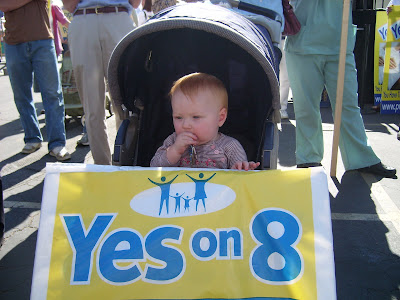
In the last few days, I've been exercising another of my constitutional rights -- the right of assembly. I attended a rally for the Yes on 8 bus tour. It was obviously staged as a media event, but I can find depressingly little news coverage of it. There was a professional photographer of some sort who took some photos of Elizabeth playing with my prop 8 sign. Since we're doing this for her, and other children like her, I thought I'd post my own photo of hope for the future.
Peter, Elizabeth and I also went to a sign waving event. They had people waving Yes on 8 signs on every major intersection of a main street in town. We were there for about an hour and a half, and got an interesting reception. The majority of cars just drove by with no response. Lots of cars honked. Many people waved, yelled encouragement, and gave us a happy thumbs up. A few gave us thumbs down or booed. A couple made obscene gestures and swore at us. If those proportions show the way people feel about Proposition 8 in our town, then there are more people who really care on the pro side than against.
I'm told that the manager of the F.Y.E. store across the street, where there were more sign wavers, called the police. Evidently several police cars showed up, but the cops told the manager that we had the right to assemble on the public sidewalk. They said that we were doing it peacefully and courteously, and there was no grounds for complaint. They told the sign wavers to be sure their cars weren't parked in that business's lot, and to stay off the grass, then the police gave them a thumbs up and drove off. This is one more instance where the people on the other side are trying to deprive us of our most basic constitutional rights because they don't like what we have to say. Luckily, in this case, the law is still on our side for now.
As a side note, I also have been seeing about the same proportions in my work calling voters for the campaign. Most don't answer the phone at all. Of those that do, most say, "Yes, I'm for 8 and traditional marriage." A few hang up or refuse to answer (which is totally within their rights), and only a very few say they are against it.
I have more hope for humanity today than I did before.
In a letter to my cousin, who was asking about this, I said:
- In a nutshell, the non-moral arguments are these:
- Saying gays have a "right" to marry under the equal protection clause of the constitution says that homosexuality is on the same footing as things like gender race and age. The problem is that anyone can claim to be homosexual -- there is no test for it -- and therefore, those that self identify have enormous political power over the rest of us.
- If sexual orientationis a discrimination class like the others, then they will invoke the decisions from other civil rights cases to:
- force churches and clergy to perform gay marriages or lose their tax exempt status.
- force photographers and other wedding service givers to give them service even if it conflicts with their religious beliefs and there are others willing to give the service.
- force religious adoption agencies to place children with same sex couples or close their doors entirely.
- preaching against homosexual behavior in church will become classified as "hate speech" and expose churches to lawsuits
- force churches and clergy to perform gay marriages or lose their tax exempt status.
- Gay marriage and gay sex will be taught in school diversity and sex ed classes on the same footing as traditional marriage, and parents will have no right to ask for their children to "opt out" of these lessons.
In the name of "civil rights for gays" which some judges find implied in the constitution, they are trying to take away our first amendment rights to freedom of speech and religion which are explicitly spelled out. That's why this issue is worth fighting for, even if you don't think it's a moral issue. - Saying gays have a "right" to marry under the equal protection clause of the constitution says that homosexuality is on the same footing as things like gender race and age. The problem is that anyone can claim to be homosexual -- there is no test for it -- and therefore, those that self identify have enormous political power over the rest of us.
In the last few days, I've been exercising another of my constitutional rights -- the right of assembly. I attended a rally for the Yes on 8 bus tour. It was obviously staged as a media event, but I can find depressingly little news coverage of it. There was a professional photographer of some sort who took some photos of Elizabeth playing with my prop 8 sign. Since we're doing this for her, and other children like her, I thought I'd post my own photo of hope for the future.
Peter, Elizabeth and I also went to a sign waving event. They had people waving Yes on 8 signs on every major intersection of a main street in town. We were there for about an hour and a half, and got an interesting reception. The majority of cars just drove by with no response. Lots of cars honked. Many people waved, yelled encouragement, and gave us a happy thumbs up. A few gave us thumbs down or booed. A couple made obscene gestures and swore at us. If those proportions show the way people feel about Proposition 8 in our town, then there are more people who really care on the pro side than against.
I'm told that the manager of the F.Y.E. store across the street, where there were more sign wavers, called the police. Evidently several police cars showed up, but the cops told the manager that we had the right to assemble on the public sidewalk. They said that we were doing it peacefully and courteously, and there was no grounds for complaint. They told the sign wavers to be sure their cars weren't parked in that business's lot, and to stay off the grass, then the police gave them a thumbs up and drove off. This is one more instance where the people on the other side are trying to deprive us of our most basic constitutional rights because they don't like what we have to say. Luckily, in this case, the law is still on our side for now.
As a side note, I also have been seeing about the same proportions in my work calling voters for the campaign. Most don't answer the phone at all. Of those that do, most say, "Yes, I'm for 8 and traditional marriage." A few hang up or refuse to answer (which is totally within their rights), and only a very few say they are against it.
I have more hope for humanity today than I did before.
Thursday, October 23, 2008
There's a study that proves...
In my conversations with people about Proposition 8 and same sex marriage, proponents often say that there's no danger in raising children in families with same sex parents. They dare you to cite one study that proves otherwise. Of course, on the spur of the moment, you can't come up with an answer because, come on, can you cite one study that proves anything on the spur of the moment?
Well Troy has saved us all the embarassment of not having a citation to hand and/or the hassle of finding just the right ones to make your point. On his blog (here's the link again), he gives an exhaustive list of "facts and sources" about the issues surrounding Prop 8.
I got this link from my brother's blog. In his post, he says, "I think that the ability of the court to overturn legislation they believe is unconstitutional is a necessary part of our government to protect the minority from the majority. So while I disagree with the court’s decision to overturn Prop 22, I can’t complain about the process for doing so. It’s not “sneaky” or “underhanded” in any way; it’s the way the government is supposed to work. However, the ability to amend the constitution is the balance to that check, and we have the ability to turn it right back."
I thought that if my brother, who is a smart guy, didn't understand why people are upset about "activist judges legislating from the bench," then there might be others who are confused too. The problem is not that the court overturned a law as unconstitutional -- that is indeed what courts are supposed to do. The problem is that the court said that since they overturned one badly written law expressly forbidding something that has never been allowed, that means that the thing which has never been allowed is now allowed, legal, and encouraged.
That's like saying that when the court overturned the handgun ban in Washington DC, everyone who wanted to could go out and buy a gun that day to keep in their homes. There are still many other laws about guns including waiting periods, licensing regulations, and permits to carry concealed weapons that still have to be followed in the wake of that decision. When a court overturns a law, conditions should return to the status quo before the law was passed, not infer that a law endorsing the opposite has been created out of thin air.
I'm going to make up a case now that has no real bearing on reality in order to make a point. I'm sure that there are problems with the legal matters in my example because of things I don't know about communications law and fraud law. Ignore those, and try to see the larger idea. Imagine that the legislature passed a law forbidding fraud using a cell phone -- fraud is already illegal, and so is committing fraud using a regular phone, but the legislature sees that somebody might say that a cell phone is a different kind of technology, and so not subject to the same rules. They write a law, which a court overturns as unconstitutional because of somethingorother (I told you there would be problems with this example, but hear me out). That does not mean that all fraud using cellphones is now legal and that any con man who wants to protect himself should just go out and get a cellphone, and then he's a law abiding citizen. Fraud is still illegal, not to mention morally wrong.
In another recent case from California. A family of eight children was being "homeschooled" by the mother. In this case, the homeschooling consisted of minimal instruction accompanied by a lot of neglect and abuse. The court said that the parents did not have a constitutional right to homeschool their kids when the mother didn't have a teaching credential, that the legal fiction they were using to enroll their children in a private school they never intended to attend was not sufficient to satisfy the law, and that the welfare concerns of these children trumped any of the other pro-homeschooling options. Parent groups were up in arms over this decision, thinking that these judges were trying to legislate from the bench, but the decision made it clear that they were concerned with this one specific case, the Department of Education did not go out that week and start charging all homeschoolers with truancy, and later court decisions affirmed that in general, homeschooling is a legal option in California. This is the way courts are supposed to work. They are supposed to say, "the law can go so far and no farther," not "this law is bad, so the opposite is now legal."
What the California Supreme Court should have done in the same sex marriage case is what the New Jersey courts did in a similar situation. They found that the state's law forbidding same sex marriage was unconstitutional, but when striking down the law, gave the legislature six months to either write a law that was constitutional, or write one that allowed same sex marriage. It's the legislature's job to write laws, not the court's.
Well Troy has saved us all the embarassment of not having a citation to hand and/or the hassle of finding just the right ones to make your point. On his blog (here's the link again), he gives an exhaustive list of "facts and sources" about the issues surrounding Prop 8.
I got this link from my brother's blog. In his post, he says, "I think that the ability of the court to overturn legislation they believe is unconstitutional is a necessary part of our government to protect the minority from the majority. So while I disagree with the court’s decision to overturn Prop 22, I can’t complain about the process for doing so. It’s not “sneaky” or “underhanded” in any way; it’s the way the government is supposed to work. However, the ability to amend the constitution is the balance to that check, and we have the ability to turn it right back."
I thought that if my brother, who is a smart guy, didn't understand why people are upset about "activist judges legislating from the bench," then there might be others who are confused too. The problem is not that the court overturned a law as unconstitutional -- that is indeed what courts are supposed to do. The problem is that the court said that since they overturned one badly written law expressly forbidding something that has never been allowed, that means that the thing which has never been allowed is now allowed, legal, and encouraged.
That's like saying that when the court overturned the handgun ban in Washington DC, everyone who wanted to could go out and buy a gun that day to keep in their homes. There are still many other laws about guns including waiting periods, licensing regulations, and permits to carry concealed weapons that still have to be followed in the wake of that decision. When a court overturns a law, conditions should return to the status quo before the law was passed, not infer that a law endorsing the opposite has been created out of thin air.
I'm going to make up a case now that has no real bearing on reality in order to make a point. I'm sure that there are problems with the legal matters in my example because of things I don't know about communications law and fraud law. Ignore those, and try to see the larger idea. Imagine that the legislature passed a law forbidding fraud using a cell phone -- fraud is already illegal, and so is committing fraud using a regular phone, but the legislature sees that somebody might say that a cell phone is a different kind of technology, and so not subject to the same rules. They write a law, which a court overturns as unconstitutional because of somethingorother (I told you there would be problems with this example, but hear me out). That does not mean that all fraud using cellphones is now legal and that any con man who wants to protect himself should just go out and get a cellphone, and then he's a law abiding citizen. Fraud is still illegal, not to mention morally wrong.
In another recent case from California. A family of eight children was being "homeschooled" by the mother. In this case, the homeschooling consisted of minimal instruction accompanied by a lot of neglect and abuse. The court said that the parents did not have a constitutional right to homeschool their kids when the mother didn't have a teaching credential, that the legal fiction they were using to enroll their children in a private school they never intended to attend was not sufficient to satisfy the law, and that the welfare concerns of these children trumped any of the other pro-homeschooling options. Parent groups were up in arms over this decision, thinking that these judges were trying to legislate from the bench, but the decision made it clear that they were concerned with this one specific case, the Department of Education did not go out that week and start charging all homeschoolers with truancy, and later court decisions affirmed that in general, homeschooling is a legal option in California. This is the way courts are supposed to work. They are supposed to say, "the law can go so far and no farther," not "this law is bad, so the opposite is now legal."
What the California Supreme Court should have done in the same sex marriage case is what the New Jersey courts did in a similar situation. They found that the state's law forbidding same sex marriage was unconstitutional, but when striking down the law, gave the legislature six months to either write a law that was constitutional, or write one that allowed same sex marriage. It's the legislature's job to write laws, not the court's.
Saturday, October 18, 2008
Diversity?
One thing that people who are against Proposition 8 keep saying is that it won't affect you or your family. They're lying. The major players in the No On 8 campaign are actively working to make sure that same sex marriage is taught as an acceptable alternitive in public schools to children when they are very young and impressionable. Don't believe me? This article has the facts about so called diversity education.
The thing that really upsets me is that in the Massachusetts case (see the video below if you don't know what I'm talking about), the judge ruled that parents can't opt their children out of such instruction. I've been a public school teacher. it horrifies me to think that if I went back to teaching I might be required to teach something I find deeply morally wrong. More than that, it bothers me to think that I'd have no control over what my children were taught. I can think of several things about this case that go completely against the current rules about opting out of things in schools.
These people don't just want to teach about other lifestyles, they want to actively promote them. That's just not acceptable to me. And telling me that this is the one thing I can't opt out of is simply ridiculous.
The thing that really upsets me is that in the Massachusetts case (see the video below if you don't know what I'm talking about), the judge ruled that parents can't opt their children out of such instruction. I've been a public school teacher. it horrifies me to think that if I went back to teaching I might be required to teach something I find deeply morally wrong. More than that, it bothers me to think that I'd have no control over what my children were taught. I can think of several things about this case that go completely against the current rules about opting out of things in schools.
- Parents have the right to opt their children out of sex education (at least up to a certain age). If this isn't sex education, I don't know what is.
- Parents of Jehovah's Witnesses children are allowed to ask that their children be automatically opted out of any discussion or celebration of holidays, among other things, despite the frequent disruption this causes in class (the disruption argument is one of the ones used to deny Masachusetts parents the right to opt out).
- Parents can request that their children opt out of ANY given curriculum they find offensive, and most schools comply without question. As a drama teacher, I had my kids do a play about some archaelogists in an Egyptian pyramid. They saw mummies and cats and spiders and snakes and a few of the Egyptian gods. Some of the kids' parents had them opt out because this was "teaching them to worship idols." I thought it was bunk -- I was telling the kids about what the Egyptians believed, and told them that nobody believed it anymore -- it was just their way of explaining the world. And mostly it was just a reason to learn how to put on a play and do some dances. But I had to respect the parents' wishes and send their kids to the library every week for a semester.
These people don't just want to teach about other lifestyles, they want to actively promote them. That's just not acceptable to me. And telling me that this is the one thing I can't opt out of is simply ridiculous.
Tuesday, August 19, 2008
Catching up with an old friend
An old friend from High School (actually my brother Mike's only HS girlfriend, if you can imagine that) contacted me this week, and as we traded emails and exchanged news, I thought that there was the makings of a good blog post in the letter, summarizing my life, and family. So here it is -- a document for history.
I went to your page and took a look at your photos -- your daughter is so cute!! It looks like she's going to be a red-head, huh? I have a lot of those in my family (lots of Scottish blood) What a sweetie!
Yeah, Elizabeth is really cute. We really hit the genetic jackpot with a red-headed girl on our first try! She also has a very easy temperament -- we call her Sweetness because, as you say, she's so sweet.
I didn't have a chance to read everything you wrote, but it looks like you have found a good, supportive group of people in your community. That's always really important. I've lived in a bunch of different places since high school, and I never feel at "home" until I've got a good group of friends.
I really do have a good group of friends here. I'm pretty shy when it comes to meeting new people, so it's hard work making friends. Luckily, most of the young mothers at Church meet Mondays at the beach, and Fridays at the park, so there's lots of time to talk.
As for Peter, I hope he finds another job soon. That's really tough, and I know a lot of people are going through what he's going through right now. I don't happen to know anyone looking for a novel editor, but I'll keep my ears open. At least there are lot of different industries in CA. I'm sure he'll find something soon.
This is the most stressful part of my life right now. Peter could do a great job in a lot of different industries, but he only WANTS to be in publishing. sigh. We do have a couple of good leads, and we're hoping one of them pans out. Until then, he has a temp job that says they'd be happy to keep him as long as he wants to stay, so at least we can get by without the whole hassle of going on welfare.
I assume you went to BYU -- when did you graduate? What did you end up majoring in? I recall that you (like all your family) were quite brilliant in high school. Did you have a career before starting you family? I always saw you as a doctor, for some reason. . .
Yeah, I went to BYU (that's where I met Peter, though we didn't get married till years later). I did a semester abroad in St. Petersburg, Russia in 1997, and graduated in 2000. I majored in Elementary Education. Directly after college, I began working for a company that makes Practice Management software for dentists, converting databases. Then I moved back to Ohio and taught school for a year until the tax base dropped out after 9-11 and all the junior teachers got laid off. I looked around and said, "I'm single and unemployed in Cleveland! What am I doing with my life?" and moved to California to start over. I lived with my grandparents and bounced around some part time jobs and substitute teaching --hoping to get a full time teaching job -- but they were having bad times in Ca too, so I ended up taking a job at an insurance brokerage doing filing and administrative work.
I got tired of some of the tedious parts of that job, and started writing programs and automating databases to make the computer to them for me. My bosses noticed, and put me on a team that was trying to do that for the entire company. It was a fun job with lots of opportunities to hobnob with the bigwigs and travel, and do creative stuff, but there was a high stress component too. The database we were working on was keeping track of billions of dollars worth of insured property and millions of dollars worth of premium, and a break down on a key day could be catastrophic. It was also my job to divine what people wanted the database to be able to do, when they couldn't put it into words themselves.
It was while I was at that job that I met Peter again, and we got married. Once our debts were paid off, I quit in order to get healthy enough to have a baby (the stress took a toll on my mental health, and that took a toll on my physical health).
I thought about going into medicine when I was in Jr. High, but quickly realized that while it might be interesting, I would be responsible for saving (or not saving) people's lives and health and happiness, and I knew that I wouldn't be able to take that kind of stress -- especially not if I made a mistake. Since I ended up with a breakdown when I was just dealing with money, I think I made the right decision.
I didn't really get a chance to ask Mike about the rest of your siblings. I know that he mentioned Doug was doing really well, and was doing some project with the Department of Defense. How is everyone else doing?
Mike's in Mt. View, Ca with Google. He's married with three boys (about 9, 4-5, and 2).
Doug just left his job in Ohio with the Air Force, and he's moving this week to Maryland, to get more schooling in his particular field of computer graphics and programming (paid for by the military) so that he can eventually make even more fancy ways to enhance and compile satellite images in realtime on the battlefield. He's married and has a son (about 4 or 5 years old).
I'm here in CA, as you know. Married with a 7 month old daughter.
David is in Oregon, pursuing a doctorate in Chemistry. He's married and has a son who's about 18 months old, with another baby on the way.
Steve just got married in March -- so no baby news yet from them. He lives in Columbus Ohio where he's working on a Master's Degree -- he wants to be a school counsellor, perhaps in an American School on a military base overseas.
Heather had her first baby, also a girl, a few months ago. She's living in Texas with her husband.
Mom and Dad are still in Amherst. Mom's parents moved in with them late last year, and Grandma has been in and out of the hospital and rehab facilities ever since, so that's rough on Mom. Daddy retired from Ford, and is having fun working on all the projects and inventions he never had time for when he was working.
I hope you'll keep me posted, and I will continue to visit your blog page to keep up with you and Elizabeth. Let me know if you're even in the Phoenix area, and we'll have to get together!
That would be fun! It's good to hear from you.
-Karen
Monday, July 21, 2008
Flylady Interview
Many of you know I'm a Flybaby -- I get Flylady's emails every day telling me what chores I ought to do that day, and it's really helped me to keep my house clean. Somebody forwarded a request for an interview to the list (some journalist is doing a story about housekeeping), and I thought I'd post my answers on my blog.
- Name:
- Karen
- Age:
- 31
- Where do you live? (City, State):
- Torrance, Ca
- Occupation:
- Stay at home mom/writer
- Married or partner?:
- Married
- Do you have children? What ages?
- One daughter - 6 mo
- How would you define yourself as a housekeeper? Explain.
- I used to be a roller coaster housekeeper -- letting chores pile up till they NEEDED to be done, now I'm much more consistant.
- How often do you clean your home? Describe your cleaning habits.
- I do some house cleaning every day. I tidy up the stuff and toys that get brought out during the day, I do a load or so of laundry, I do the dishes as soon as I finish eating (no dishes get to sit in the sink -- though I do have a dishwasher, which helps). I also wipe the counters and stove/microwave every day
Once a week or so, I clean the bathrooms and vacuum, and sweep and/or mop the kitchen floor. - How satisfied are you with the cleanness of your home?
- Very satisfied. I'm very proud of my home
- If you are satisfied or dissatisfied, explain why.
- When I was in roller coaster mode, I put things off, then felt guilty seeing clutter or dishes or laundry, and I didn't want to think about it, so I ignored it till it was really bad. Then, I'd finally get up the energy to clean, and I'd work very hard till I was exhausted. Then I'd feel like I could take a week off from working, and the stuff would pile up again.
Now, by doing a little every day, it doesn't pile up, and I don't feel guilty, and I don't have to work till I'm exhausted. I'm at peace in my home, and people are impressed when they come over.
- How important do you think it is to have a clean home?
- I think it's very important to have a CLEAN home for reasons of health and mental health. It's less important to have a TIDY home -- it should be OK for kids and parents to live in the house. A day or two of mess for a big project or if somebody's sick, is just fine. And if you keep it consistantly clean on a regular basis, it'll be easy to tidy up after that mess.
- Do you hire a housekeeper? If so, how often does the person comes?
- No
- Do you find that many times you leave all the cleaning and de-cluttering to the housekeeper and sometimes even feel embarrassed when he/she comes?
- Do you notice a difference between generations as to the importance given to keeping the home clean? If so, what differences and among which generations?
- Do you notice a difference between generations as to the importance given to keeping the home clean? If so, what differences and among which generations?
- I think that at different phases in one's own life there are different standards. When you're a kid, you think there are more fun things to do than clean house. When you move out on your own, you have to find a balance, and it's easy to swing to extremes before finding it. It's easier to keep things clean before kids, and so parents may relax a bit.
I think that in my grandparents' generation, the people who lived through the Depression and the War often either hoarde things or travel light, and that can make for very dirty or very clean houses.
I think there's a lot more variation in personalities and how you were raised in regards to cleanliness rather than blanket statements for whole generations. - How would your mothers rate your home if they went for a visit?
- My mom thinks I do a great job keeping house, and she's told me so.
- Do you have the same standards of cleanness as your mother did? Explain why or why not.
- Yes and no. I get a lot more anxious about mess than my mom did, so I probably keep my house cleaner than she did -- though I haven't got six kids yet, so I don't know how I'll be when there's more people making a mess. At the same time, Mom taught me how to clean, and how to tell when something needs cleaning, so a lot of my viewpoint is based on hers.
- Do you find that many times your mother or mother-in-law, when they come to visit, end up inspecting the cleanness of your home, or give you recommendations on how to organize it and clean it better? Do you have arguments with them because of this? Please describe and offer a lot of anecdotes on this aspect.
- My mother in law also thinks I do a good job. We have a great relationship, and if she had suggestions, I'd seriously consider them as coming from a loving helpful place in her heart. I even sometimes call her for advice about things (though not always housekeeping).
- Do you think that your children (whether they are grown or not) and your husband/partner care less about cleaning the home as you do?
- My husband definitely cares less than I do -- but he's supportive, and will do a specific task if I ask nicely and show him how it's done. We also have a kind of truce about certain things -- I don't mind if he leaves it out, if he doesn't mind if I put it away.
- Do you think men are participating more in the house chores?
- My husband participates about as much as my dad did in the everyday housekeeping. Neither does very much, but neither classifies it as "women's work" either. I care about it, so I do it. He doesn't, so he doesn't. But he cares about ME and he'll do what it takes to keep me happy -- including voluntarily doing dishes, taking out the garbage (sometimes without being asked), etc. I also ought to point out that bith my husband and father work(ed) full time to let their wives stay home and raise the kids.
- How do you think the next generations will deal with the issue of housekeeping from what you can see today? Will they care more, care less, and why?
- I think it'll be about the same. They may have better technology to help them (like I have better than my mother and grandmother did, but they'll still have to make the same decisions about a balance between time and comfort.
- Do you feel that the economic recession in any way impacted how often you clean your home? For instance, have you fired the housekeeper you had, are you cleaning less because you are overworking, etc.
- The recession has definitely had an effect -- My husband lost his job, so he's home all the time. This gives me the ability to have him take care of the baby so that I can focus on cleaning and cooking (which I didn't do much of before he lost his job).
- How cluttered is your home?
- I don't think it's cluttered -- based on what I've seen at other people's houses. On the other hand, we use ALL of our storage space.
- Do you keep many things that you don't need? Like what?
- I have a lot of craft supplies, children's toys for ages that I don't have in my house, LOTS of costumes, and LOTS of books. Are these things I don't need? I dunno -- I don't often use any given thing, but I often am happy that I have just the thing I was looking for when I want it. I try to give myself a limit on how much space the stuff can take up, and when I want to get a new thing, I have to make room for it by getting rid of something else.
- Where do you keep stored most of the things that you no longer use or need?
- Closets
- Does it make you feel anxious to have so much clutter?
- No -- I don't have more clutter than I can put away, and if it's put away, it doesn't make me anxious.
Subscribe to:
Posts (Atom)
